
News
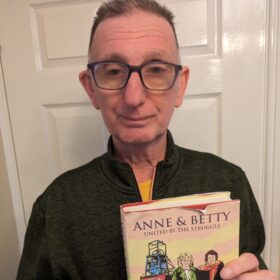
Charlie, ‘Honorary Member’ of Women Against Pit Closures
In the mid 80s, whilst the miners’ strike was the focal point of my community, I was doing a degree in Behavioural Science as a (im)mature student at Huddersfield Poly.
In my final year I had to choose a subject for my 10,000 word dissertation and so, coming from Barnsley, I chose to write about Women Against Pit Closures and the changes that came about as a result of that movement.
I referenced it with classic sociology texts such as Family and Kinship in East London by Young and Wilmott and I sprinkled it with Marxist references including the State and Revolution by Valdimir Lenin. Word processors were just about being born, so we had to find people to type dissertations up. After they read my text, the first person who was to type my dissertation went on their own strike because I appeared to be a revolutionary.
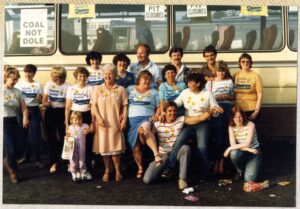
Credit Unknown – Courtesy of NCMME
The practical part of my dissertation concerned attending and knocking about with Barnsley Women Against Pit Closures. I had a ball!
I borrowed the media department’s chunky video camera, filmed conferences and rallies and other events, and interviewed them. We even hired a minibus and took them picketing to Barnoldswick for the Silent Night dispute, where we had a ‘few drinks’ on the way back.
One woman went on to write a book of poetry about the strike and I got it illustrated for her by the art students.
I attended meetings and it was eventually passed that I was to become an ‘Honorary Member’ of Women Against Pit Closures.
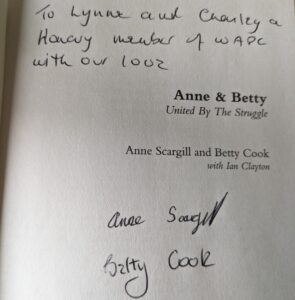
I was overwhelmed by the warmth and generosity of the group and am very proud to have been made an Honorary Member of WAPC.
I can’t wait to see We’re Not Going Back at the Grove Hall, South Kirkby and raise a glass to those women of the working class! Book tickets here
Charlie Robinson – Leader of South Kirkby and Moorthorpe Town Council
A timeline of the 1984/85 miners’ strike by Yorkshire Bylines’ John Heywood
The 1984-1985 miners’ strike marked one of Britain’s most bitter industrial conflicts. It erupted after the National Coal Board, under the government of Prime Minister Margaret Thatcher, announced plans to slash national coal production and shut down twenty mines, costing 20,000 jobs. Towns and villages across the United Kingdom, heavily reliant on these mines for employment, faced severe hardship and the loss of their communities.
By the early 1980s, coal mines were already struggling financially. The Government’s announcement exacerbated the situation, leading to growing discontent. Calls for strikes had been brewing since the successful labour actions of the 1970s. In March 1984, miners in Yorkshire initiated strike action, prompted by the impending closure of Cortonwood Colliery in South Yorkshire, leading the National Union of Mineworkers (NUM) to declare a nationwide strike on 12th March, albeit without an official vote.
Anticipating the strike, the Government had stockpiled six months’ worth of coal. They also prepared through the National Recording Centre (NRC), established by the Association of Chief Police Officers for England and Wales (ACPO) in 1972, to coordinate police response and manage protests, including dealing with flying pickets. This is the story of that strike:
1984
The National Union of Mineworkers (NUM), led by Arthur Scargill, called for a nationwide strike in response to the National Coal Board’s (NCB) announcement of plans to close numerous coal mines, resulting in significant job losses within the industry.
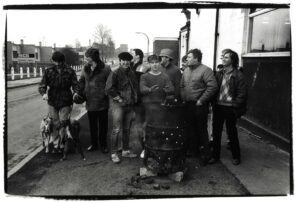
Picket Line (c) Credit Ross Williams courtesy of National Coal Mining Museum
March: This month saw the escalation of the miners’ strike, with South Wales miners initially showing limited support, as only ten out of 28 pits voted in favour of strike action. However, on the 11th of March, the arrival of flying pickets in South Wales rapidly expanded the strike’s reach. The following day, Arthur Scargill declared a national strike without conducting a formal ballot, marking a significant turning point in the dispute. Throughout the month, violent clashes between pickets and law enforcement escalated, while the Thatcher Government initiated coal stockpiling measures to mitigate potential supply disruptions. Tragically, on the 14th of March, Wakefield miner David Jones lost his life on the picket line in Ollerton Nottinghamshire. Despite these events, several areas continued to vote against strike action in local ballots.
April: In April, the Women Against Pit Closures movement became a force to be reckoned with as women united in local communities to support striking miners’ families. The momentum continued into the next month with a powerful rally in Barnsley, drawing approximately 5,000 women. Subsequently, they convened a conference, and later in the summer, orchestrated a poignant protest march in London, where over 23,000 women took to the streets of the capital in solidarity.

Women Against Pit Closures (c) Ken Wilkinson courtesy of National Coal Mining Museum
Summer: As the strike progressed, tensions escalated between striking and non-striking miners and the police, particularly at picket lines. Yorkshire, along with Nottinghamshire and South Wales, became a focal point for sometimes violent clashes. Two incidents inflamed the tensions even further.
On 15 June, tragedy struck at Kellingley Colliery in Yorkshire when Joe Green, a miner on the picket line, lost his life. A lorry, attempting to enter the pit, mounted the pavement and fatally struck him.
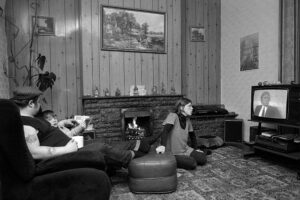
Brian, Paul and Denice Gregory watching Channel Four News Cuba Street. Easington Colliery. (c) Keith Pattison
Just three days later, the infamous Battle of Orgreave unfolded. Approximately 5,000 pickets congregated outside Orgreave Colliery, aiming to obstruct the passage of coal-laden lorries entering the plant and coke departing from it. Responding to the scene, around 5,000 police officers equipped with riot gear, mounted police, and dogs arrived to dismantle the picket line. What ensued was a violent clash between the two sides. In the chaos, fifty-one picketing and seventy-two police officers sustained injuries. Following the altercation, ninety-three miners were arrested and faced charges of rioting, marking a distressing escalation in the tensions.
Autumn: The legality of the miners’ strike was called into question due to the absence of a national ballot among NUM members. Following this ruling, a gradual return to work began among some miners.
In November, a tragic event added to the toll of the strike. Paul Holmes, 15, and his brother Darren, 14, were killed when an embankment collapsed on them at the pit village of Goldthorpe, near Barnsley. They were collecting coal which they were planning to sell for pocket money. Local residents and the emergency services tried to dig the boys out. They both died as a result of their injuries.
1985
January: Despite the winter months and mounting pressures, the strike continued into the new year. Yorkshire miners, along with those in other coal-producing regions, remained committed to their cause, despite the challenges they faced.
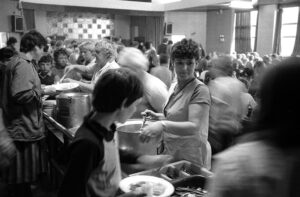
Easington Colliery Club. Marilyn Johnson serving lunch during the school holidays (c) Keith Pattison
February: As the strike entered its eleventh month, the NUM leadership faced growing criticism and internal divisions over its handling of the dispute. Many miners, disillusioned by the lack of progress and facing financial hardship, began to return to work without a settlement.
March: On March 3rd, the NUM officially called off the strike, effectively ending one of the longest industrial disputes in British history. However, the return to work was not uniform, with some miners remaining on strike while others reluctantly resumed their jobs in the face of dwindling support and mounting debts.
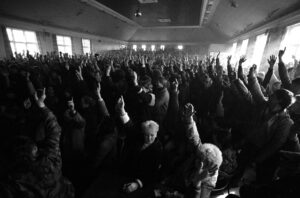
Easington Miners’ Welfare Hall. Lodge Meeting to vote for an end to the strike with no agreement (c) Keith Pattison
Aftermath: The strike’s legacy looms large over Yorkshire and other mining communities, with profound economic, social, and political consequences. Many pits, unable to recover from the strike, were closed permanently, leading to widespread unemployment and the decline of traditional mining towns and villages. Communities were lost and the impact on post-industrial towns and villages is still being felt today.
The 1984/85 miners’ strike remains a defining moment in British labour history, highlighting the enduring resilience and solidarity of working-class communities in the face of economic hardship and government policies. The tragic deaths, along with the violent clashes at Orgreave, serve as stark reminders of the human cost of the dispute and the deep divisions that characterised the strike.
by John Heywood
Main image courtesy of NCMME

Director Elvi Piper’s inspiration & hopes for Red Ladder favourite ‘We’re Not Going Back’
The first piece of theatre I saw when I moved to Leeds 10 years ago, on maybe my second or third night in the city, was Red Ladder’s ‘Playing the Joker’ at Leeds Playhouse. The little front of house area curtained off into a pop-up venue was heaving, and the audience laughed and commented and nodded along knowingly to the unravelling tale of Eddie Waring’s life. It wasn’t like theatre experiences I’d had before – it felt like a local pub on quiz night, unexpected, come-at-able and a little bit unruly – I loved it. Red Ladder has always been a bastion of front-footed political theatre that tells stories where people actually live them, and as a theatre-maker in Leeds I couldn’t feel more privileged to be trusted to tell stories for them.
When I was offered the opportunity to direct ‘We’re Not Going Back’ ten years on from its original staging, I was thrilled (and, I’ll admit, a little bit intimidated too) to be handed responsibility for a show that already means so much to Red Ladder’s audiences and the team who first created it. This play tells a story about the miners’ strike I’d never really heard before, from the experience of the women affected; the women at the heart of the communities impacted, who organised groups, fed people, stood up, stood by, held up, marched, worked, picketed, defended, fought, survived…
Women Against Pit Closures (c) Ken Wilkinson courtesy of National Coal Mining Museum
Plus you’ve got Boff Whalley’s brilliant script and music, brought back to life by the outstanding original all-female cast (back in the roles they played a decade ago), with live music arranged and performed by the magnificent Beccy Owen – there’s a lot to be excited about in this show!
I hope we can bring all the ingredients of this show to life in a version that speaks to the original production but gives audiences something new too! We’ve stripped back the set to play with a collection of choice props to tell this story in a way that reflects the resourceful, practical, enterprising spirit of our three heroines and ties us to the era. We’ve also been given a lot of freedom to play with the text in the room, to examine the shifts in language, storytelling and performance styles since the show’s last outing – and there’s even been the gift of some new music to add to the stupendous soundtrack! Lots of new things to excite audiences, but with the much-loved bones of this brilliant show as they ever were.

L-R Beccy Owen, Stacey Sampson, Claire O’Connor, Elvi Piper & Victoria Brazier in rehearsals
During this process I’ve learned so much about the events that took place in the year the play spans (1984-1985) and the experiences of the people and communities impacted by the miners’ strike. The shockwaves of the strike have shaped the lives of generations to come, and the experiences of the play’s characters 40 years ago are eerily and frustratingly familiar today. I’ve also been overwhelmingly inspired by the incredible stories of defiance, empowerment, and determination in the face of adversity that this process has thrown in my path; and I hope audiences will be too. I hope they’ll leave this show inspired, outraged, smiling, swearing and singing – entertained, affected and even ‘changed’ by the art on the stage in front of them.
Headshot of Elvi Piper (c) Lian Furness

We’re Not Going Back by Boff Whalley
People love anniversaries. Royal Jubilees, Cup victories, Elton John’s birthday. We’re Not Going Back was written ten years ago, to commemorate the miners’ strike on its 30th anniversary, because some anniversaries (unlike the above) are worth remembering. For anyone too young to remember it, that year was pivotal. It spelled out the class divide, the money divide and the power divide.
I wrote We’re Not Going Back because Unite the Union had requested of Red Ladder some kind of theatrical commemoration. My first thought was, yes, I’d love to write a musical about the strike. But I don’t want it to be about miners and cops fighting on picket lines. I want it to be about the women who embodied the spirit and passion of the strike.

Easington Colliery. Back Alma Street. Returning home from work.
So myself and director Rod Dixon went and met with some of the women involved in the Women Against Pit Closures support groups. They were hilarious, fantastic, full of stories (some of which made their way into the play. Hint: the sheep).
Writing dialogue for female characters is always more fun than writing for male characters – women talk to each other, they get down to brass tacks a lot quicker than men. In that sense this play was a joy to write. And the music – working with Beccy and the cast was a privilege ten years ago and is a privilege today. Such amazing voices, and such a sisterly bond between them all. I’m not ashamed to say that when they sing ‘What Price Coal?’ it still makes me cry. And then again, they’re just as likely to make me laugh at a joke I’ve heard a hundred times.

Tower Street. Jossie Smith, retired and disabled miner arrested outside his home, with his wife. February 1985
It wasn’t all fun. How the miners were treated by the government, the press, even by the Labour Party, was a shocking and depressing story to have to re-tell. This made it all the more important to write – the arts has a duty to paint pictures of our collective history much more accurately than academic history books or TV news.

School holidays. Easington Colliery Club
What is significant in this 2024 version of We’re Not Going Back is that, as we talked about at the first rehearsal, the struggle for justice for the miners arrested and beaten at Orgreave is still continuing today, forty years on, as the Orgreave Truth & Justice Campaign. I hope that this play can honour that ongoing campaign, and the history of such a defiant moment, 40 years on.
All photos: Keith Pattison, as featured in his book ‘No Redemption The 1984-85 Miners Strike in the Durham Coalfield Easington Colliery
Main photo: The 1984-85 Miner’s Strike in the Durham Coalfield. Easington Colliery Club. Marilyn Johnson serving lunch during the school holidays.
Book tickets for ‘We’re Not Going Back’ here!
Our new Artistic Director, Cheryl Martin on her family’s shared history of mining and activism
I’m less than a month into my post as Artistic Director of Red Ladder and yet working alongside a small team who achieve the seemingly impossible each week, and the excitement of bringing back a show which is already proving a huge draw to audiences, is powering me through the days.
‘We’re Not Going Back’ opens in Sheffield next month to mark the 40th anniversary of the miners’ strike, and is exactly why I wanted to be part of this company. It’s funny, it’s warm, and the characters are people we know – family. Three sisters who become part of the strike, joining the pickets and organising everything from fundraising to packed lunches: leaders, not just supporters. And all while bickering, laughing, and fighting: for their families, their neighbourhoods, their towns, for the lives they knew. A fight that would change everything.
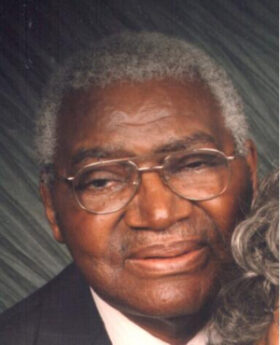
It reminded me of when I saw the film Matewan, by John Sayles, only a few years after the miners’ strike ended but over three and a half thousand miles away. I was staying with my grandmother in Washington, DC, and came back from the movie talking about the Pinkertons [mercenaries, armed and hired in] strikebreaking and killing miners during the West Virginia Coal Wars of the 1920s. Then my grandmother said, “Yeah, I remember when the Pinkertons came to Gary [West Virginia, where my mother grew up],” and I was gobsmacked. I sat and listened, and listened, and listened. They’d lived through the kind of battles I’d just seen on screen. And I had never known, until that moment, what they had to do to make a life worth living for my brothers and sisters and cousins. And me. And I hadn’t realised that my Uncle Francis [Francis Lewis Martin – pictured above] was the first African-American on the United Mine Workers of America’s International Executive Board. I hadn’t realised that his brother, my Uncle Junior [Napoleon Bonaparte Martin Jr], had been on the grievance committee of his local UMWA branch since 1963 – the year of Martin Luther King’s “I Have A Dream” speech – and then local president.
Last week, I met one of the cast from ‘We’re Not Going Back’, Victoria Brazier, in her real-life union organising role, pinch-hitting for a Yorkshire colleague at the Sheffield branch of performance industry union Equity. Executive Producer Chris Lloyd and I talked about Red Ladder’s earliest days – born from demos back in 1968 – and how activism is still at the heart of our work, partnering with Unite the Union for this upcoming tour.
That film, Matewan, unlocked sixty-year-old memories in my family of how they fought for their part of the Appalachians, memories to put fire in our bellies while fighting Reagan’s anti-union crusade. This play, We’re Not Going Back, reaches forty years to find the camaraderie and love and belief we need to power us through this age when some people are losing their belief in grassroots politics and the strength that comes from fighting together for what matters most: family, community, a future.
As Mary from We’re Not Going Back says,
“And once you’ve got over the fear of getting up, then the words are queuing up to get out and you’re saying good things, important things, words so full of meaning much. And then the words get louder, and the spaces get bigger – and everyone in the room is holding your hand and willing you on, you’re part of something, a band, a community, a movement. And it’s a glorious thing.”
Book your tickets now for the upcoming tour of ‘We’re Not Going Back’
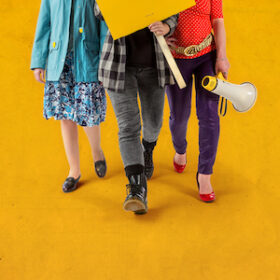
Return of our all-female hit musical comedy to mark an historic anniversary.
We’re beyond excited to announce that we’re reprising We’re Not Going Back, in collaboration with Unite the Union, in recognition of the 40th anniversary of the 1984/85 miners’ strike.
The show chronicles the industrial action through the eyes of three very different sisters, united by their common cause.
Following its opening at Wortley Hall, Sheffield on International Women’s Day – 8th of March 2024 – We’re Not Going Back will then tour across the North of England including Leeds, Sheffield, Huddersfield, Doncaster, Scunthorpe, Wakefield, Washington, Barnsley, Hull and Goole.
Created by writer and ex-Chumbawamba founder member Boff Whalley, the production will be re-directed by Elvi Piper. Victoria Brazier, Claire-Marie O’Connor, Stacey Sampson and Beccy Owen will reprise their original roles as the sisters driven to protest.
Unite the Union are perfect partners, as Regional Secretary Karen Reay explained, “Unite the Union North East, Yorkshire and Humber Region, and our very own Women’s Committee, are proud to be working with Red Ladder to re-stage “We’re Not Going Back”. Marking 40 years since the start of the miners’ strike, what better way to celebrate International Women’s Day than with this emotional and funny play shedding light on the vital role of women during the strike. Looking back and learning from our history is vital to looking to the future of the trade union movement. This play is as poignantly relevant today, as it was 10 years ago when it first ran.”
Writer Boff Whalley agreed, “For me, the strongest part – the heart of the miners’ strike – was always the family support, specifically the wives, mothers, sisters and daughters.”
“Despite the outcome of the strike, all the hardship and poverty, the main memory of that year for the women was of laughter, fun and surprise – a big adventure. How to take on the machinery of the capitalist state; and have a good time doing it.”
We’re Not Going Back reminds the audience of the resilience of working-class communities. The make-and-mend fabric of family life and the power of sticking two fingers up to a government hell-bent on destruction. All seasoned with song, good humour, and a six-pack of Babycham! We hope you can join us in March.
“A seminal piece of agitprop that avoids cliches and propaganda in favour of the personal politics behind the ‘phony’ media headlines.” The Stage 2014
“Brilliant! Wonderful songs. Great dialogue. Funny. Go and see it!” Audience member, 2014

Cheryl Martin joins Red Ladder Theatre Company as new Artistic Director
We are thrilled to welcome theatre director and writer Cheryl Martin as our new Artistic Director from January 2024, following Rod Dixon’s decision to leave the company after his 17-year tenure as our artistic leader.
Alongside her work writing and directing award-winning theatre productions, Cheryl has also fulfilled a variety of roles including supporting writers and practitioners at Contact Theatre, Traverse Theatre Edinburgh, and Oldham Coliseum. Cheryl has also worked with Community Arts Northwest on a series of community plays, devised with, and starring mostly women refugees and asylum seekers.
In 2015 she co-founded LGBTQ+ Global-Majority performance arts company Black Gold Arts, a celebration in choreography, writing, directing and cabaret, which was part of the Eurovision cultural festival. Black Gold Arts recently won the Best Event category at the Manchester Culture Awards for its free outdoor arts festival at The Whitworth in 2022.
In addition to being an Edinburgh Fringe Total Theatre assessor and judge, Cheryl was also Co-Artistic Director of Manchester’s grassroots Global-Majority-led publisher and writer development company Commonword and is Co-Director of Manchester Pride’s Candlelight Vigil.
Fiona Gell, Co-Chair of Red Ladder’s Board of Trustees said: “This is a historic moment for the company. We could not be more delighted that Cheryl will be joining as our new Artistic Director. We’re excited to see how the company will evolve under her dynamic artistic leadership, as she is an extraordinary practitioner with a great deal of experience and a wealth of ideas. Together with the Red Ladder team, the company will continue to play a leading role in developing compelling productions, with social justice and unheard voices at their heart. We would also like to thank Rod Dixon for his amazing 17-year contribution and wish him well in his new venture.”
Following the announcement of her appointment Cheryl Martin, Artistic Director of Red Ladder Theatre Company, said: “For me this is THE dream job! To be able to work with a company with so much history and reach into so many communities. Red Ladder is always shape-shifting, evolving, and changing its approach. A place where all the plays are new ways to connect with a working-class audience, where those connections are cherished, and where every show, the staff and the board, are dedicated to finding and amplifying the voices and stories of people who are so often unsupported.
“I feel incredibly lucky. I get to develop artists, to look for new audiences and the people and shows that will appeal to them, and I get to direct every now and then. I get to work with a team who are passionate about what they believe in and deliver a massive amount of compelling work. Of course, it’s a dream job!”
Emma McDowell, Co-Chair of Red Ladder’s Board of Trustees, said: “The working group managing the recruitment process felt such an incredible amount of responsibility of doing right by this great company and the work of the team past and present.
“Red Ladder has such a rich history of addressing critical social issues, pushing creative boundaries by producing entertaining and engaging theatre, supporting creative practitioners and working with local communities. We’d like to pass on our thanks to all those who applied and who supported the recruitment process from the beginning, and to Arts Council England for their continued support.”
Find out more about our new Artistic Director
Since her very first theatre job as Writer-in-Residence for community and theatre-in-education company Pit Prop in Leigh, Lancashire, Cheryl Martin has been telling stories not usually heard in theatres.
From her earliest work, writing an award-winning musical set on Oldham’s Tommyfield Market [Heart & Soul, Oldham Coliseum, Manchester Evening News Award for Best Community Play] to creating an early immersive exploration of the Amritsar Massacre [Dhalta Suraj (The Sun Sets), Pit Prop, Bolton], to adapting slave narratives for BBC Radio 4 [Incidents in the Life of a Slave Girl, Harriet Jacobs] or classics like Howard Sackler’s The Great White Hope or James Baldwin’s Amen Corner for BBC World Service, she’s always been drawn to bringing things society wants to bury to the surface. I am because we are, written for Contact Theatre in Manchester [2017] continued this line in Cheryl’s work, delving into the experience of black Africans living with HIV in Manchester, campaigning to lessen stigma. Cheryl’s solo show Alaska was part of A Nation’s Theatre, and the 2019 Wellcome Collection’s Festival of Minds and Bodies and Summerhall Edinburgh Fringe, and the film One Woman [Unlimited Wellcome Partnership commission], based on a solo show, toured festivals including the Unlimited Festival at the Southbank Centre, Barcelona’s L’Altre Festival, and Edinburgh’s 2021 Summerhall Digital Fringe.
As a director, she got her start at Contact Theatre [Manchester] in the Arts Council England’s national programme Live and Direct for emerging black and Asian theatre directors. And she was lucky enough to get a job at Contact a couple of years later, as Associate Director, New Writing/New Work, running that Live and Direct masterclass series for three years, as well as creating a Spoken Word series of labs to help writers create unconventional theatre, running a Young Writers Festival and residencies, incubating new companies, a popular scratch night, Flip the Script, and seed commissions and R&Ds and a lot more.
Contact also looked for new voices not usually heard or seen, from communities still scarce in the theatre world – white working-class, LGBTQ+, Global Majority, women, disabled artists. She also won another Manchester Evening News Award, this time as a director for women-in-prison drama Iron by Rona Munro [Working Girls, Contact; MEN Award for Best Studio Production]. She took all that with her in her work: finding the then-new working-class writer Alan Bissett in his first theatre play, The Ching Room [Oran Mor/Traverse, nominated for Critics’ Awards for Theatre in Scotland]; co-directing a Fringe-First-winning series of breakfast snapshot-of-the-nation plays, The World is Too Much [Traverse].
Back in Manchester, Cheryl spent eight years working with Community Arts Northwest on a series of community plays devised with and starring mostly women refugees and asylum seekers, culminating in the Lloyd’s Bank Regional Theatre Award-winning Rule 35 [CAN], in which the audience became refugees in an immersive show in which the refugee and asylum-seeker women played immigration detention guards.
Her most recent directing work testifies to the wide variety of styles and subjects Cheryl loves to work with: This Town [Contact, Derby Playhouse, touring] by young white working-class writer Rory Aaron; Orpheus & Eurydice [R&D, HOME, Manchester] by young non-binary Global Majority writer Maz Hedgehog and looking at what a butch-femme relationship might feel like if it were happening among gods and nymphs and mortals right now and Dominoes and Dahlias (+ Oware!), [Royal Exchange, touring since May 2022 and still going], devised with and starring Caribbean and African Elders. The latter has just won the award for ‘Best Age-Friendly Outreach’ in the Fantastic for Families Awards run by the Family Arts campaign. They were joint winners with Doncaster Cast in a strong field of six nominees. Cheryl also recently worked on The Walk: A Sleeping Child, the launch of the giant puppet Little Amal [MIF 2021], about the nightmare journey of a refugee child, and made it work even though the puppet wasn’t there!
Cheryl was writer-in-residence at Oldham Coliseum and worked as a director at the Royal Exchange and the Traverse. In 2015 she founded LGBTQ+ Global-Majority performance arts company and registered charity Black Gold Arts (BGA) with choreographer Darren Pritchard and producer Jayne Compton.
BGA started with only £1000 for a whole festival and grew to a week-long celebration with 33 national venues and companies coming to an Industry Day, along with masterclasses in choreography, writing, directing, plus a cabaret the very next year. BGA’s weekend outdoor takeover of Manchester’s Whitworth Gallery has just won the Manchester Culture Award for Best Event, and last May they were part of the Eurovision cultural festival.
She also served as an Edinburgh Fringe Total Theatre assessor and judge, and as Co-Artistic Director of Manchester’s grass-roots, Global-Majority-led publisher and writer development company Commonword, which got her theatre career started by recommending her for that first Pit Prop residency. Cheryl is a Co-Director of Manchester Pride’s Candlelight Vigil with Kate O’Donnell [TransCreative Artistic Director] and Nathaniel Hall [It’s A Sin, The First Time, Dibby Theatre Artistic Director] and loves working on it every year.

The Making of TAXI
A Writer’s perspective from Andrea Heaton, based on an original concept from Douglas Thorpe
Taxi opened it’s doors this August at The Old Woollen, Sunny Bank Mills, Farsley. A collaboration between Red Ladder artistic director Rod Dixon and mad dogs dance choreographer Douglas Thorpe it was many years in the making. The Writer, Andrea Heaton (Heaton (Smile Club, Jack Frost, Football Freddie) shares her thoughts on the making of TAXI.

When I first visited R&D over three years ago the pair had already created a collection of intertwining characters with enough back story for a long running series. At the centre of it all, the Taxi Driver, a character who most of the time said very little at all. Peppered with ideas and moments of Doug’s own experience as a driver, there was a strong sense of this character’s emotional experience but not what his own identity or story might be. When I began to develop the script I decided to lean into this idea as a concept for the whole piece.
Why would this character, who spent his day travelling where he was told, trying to keep his head down, making sure not to talk about anything too risky like religion or politics, why would this guy be the main character? Taxi needed an imperative, a reason to speak; what better than to make Taxi’s story a matter of life and death?
Watching Douglas, and the skilled dancers who have developed Taxi, work was a change of perspective for me. As a writer so many characters start on the page, as an actor I’m led by the voice, by tone and use of language. But mad dogs company characters were in their bodies, deftly expressing the desires, needs and fears of the protagonists without exposition heavy dialogue.
This show could not be naturalistic, it would be physical and viscerally live. Working across genres, with a creative team who are not particularly interested in following the rules of theatre or dance, I had the freedom to write something I had never written before. I wanted to give Doug the space to create epic movement landscapes while telling a story that was intimate and compelling. I wanted to invite the audience on an emotional and spiritual journey with us.

I started by imagining the parade of customers who sat in Taxi’s cab day after day. They could be anyone, all blissfully unaware of who had sat in their seat beforehand, and each with their own agenda. Our Taxi driver catching glimpses of their multi-faceted lives and stories before they disappear from his world. Of the thousands of stories that one taxicab might contain, whose stories do we want to hear? Who do we miss?

After a three year journey with the project, and some expert navigation from dramaturg Lindsay Rodden, my script is now in the hands of the brilliant team Rod has assembled. Zac Doughty’s set design will put our audience right at the heart of Taxi Driver’s world. Ed Heaton (Sound Designer and Composer) and Adam Foley (Lighting Designer) are plotting away to create an immersive experience through the city and beyond. The exceptional multi-rolling cast of five, Maya Carroll, Gerald Headley, John Kendall, Stephania Pinato and John Rwothomack are joined by a community chorus of Leeds folk in signature Red Ladder style.
Taxi is the story of a city, how the pieces fit together to make a whole. It is a story about humans, our loneliness and our desire for tangible connection. It is almost certainly not the story I would have written pre pandemic, it was not the route I expected to take. But here I am, and here you are, this is our journey now- this is who we are.
TAXI is at Leeds own Old Woollen, Sunny Bank Mills, Farsley, from August 10th, I hope you’ll join us.

Red Ladder Theatre Company and mad dogs dance theatre present: TAXI- an interview with the Co-directors Rod Dixon and Douglas Thorpe
Written by Andrea Heaton, Co-directed by Rod Dixon and Douglas Thorpe, based on an original concept by Douglas Thorpe
Taxi is a brand-new premiere from Red Ladder Theatre Company & mad dogs dance theatre, what can audiences expect from this piece of dance and drama?
Rod: I want us to blow away expectations. I mean audiences may have expectations from previous Red Ladder work, but want the audience to be surprised, to be given a spectacle they’ll never forget, this is visceral. People who don’t like dance or theatre will hopefully be reached, TAXI may well intrigue people. We want to bring in people who don’t normally go to see theatre or dance. For us, success will be them leaving after seeing the show and saying: ‘I wasn’t expecting that at all!’
Doug: Agreed. The worst thing would be that we created nothing new, or what the audience expected. We don’t want to replicate what people have done before – that’s what the arts are about, creating something new. Something different. We don’t want to be repeating ourselves.
Rod: Yeah absolutely… I worked with a theatre group considered by critics and audiences to be exciting, yet they were producing exactly the same stuff that they’d been producing 30 years ago. For me, that formula doesn’t work if you don’t stretch yourself as an artist.
We’d seen it all before, using the same stuff, and this collaboration we’re doing now is partly because we both wanted to work outside of our comfort zone. Perhaps in a way that isn’t safe but that’s the endless struggle of art and theatre; how can you take a risk if you need to follow a business plan and if you’re creating art solely for profit, then it isn’t really art.
If we make audiences come out feeling a little uncomfortable, and maybe younger audiences might not have seen anything like this before, live.
Doug: A lot of the script is based on all of the people that I met when I was a taxi driver. It’s all of their stories that I heard, and we are retelling those stories. Some of them are a little more direct and they are also the stories of those people that you don’t get to hear from. That’s what really appealed to me, to be able to share all of those voices that you don’t usually get to hear. And it is not all doom and gloom, it was beautiful to meet someone…
Rod: It’s a slice of urban life, something surreal, but then what you can see out of your car window, and sitting in your taxi at 1 am, CAN be surreal.
Q: It’s quite dark subject matter, what was the inspiration for this piece?
Doug: It isn’t all dark though because sometimes you meet people who are beautiful and so full of life, who you can have great communication with and that’s the perfect scenario of what a taxi driver can experience in a single day.
As a creator, I’ve made pieces of work but not really understood them. But with Taxi, you’d meet people who were clearly struggling financially, yet those were the sort of people who would give you a tip. Couldn’t believe the amount of time you’d pick up people who were clearly financially well endowed, but one of the reasons for that is that they are so well off is because they are greedy and inconsiderate of anyone else.
Yet it is often those that are struggling, that are the most generous and recognise the job that you are doing and are grateful for it. And in TAXI, I think I wanted to capture all of those people, all levels of the human spirit and to capture their voices and share their stories.
Rod: What we are looking at is the everyman and the audience will go away and reflect on their own life and how they leave a mark. The whole thing is about what is life and death, what is the point. People want to leave a mark, but the reality is, that not everyone has ‘statutes’ dedicated to them. How much do people accept just being a benefit to others being enough in life? People aren’t comfortable that things might fail. It’s not so much dark as deep, there’s a depth we are trying to reach, and it’s going to be a challenge. And it might not work!
Doug: That really scares me as an artist because I can be in situations where I can’t afford to fail. I have to go back to things that I know can be successful. So I get pushed into the corner of repeating things. It helps to be in a situation where we recognise that failure is healthy.
Rod: Hopefully, those failures happen in rehearsal. But I’ve been doing this for years and you never know how the audience is going to respond. Opening night is still nerve-racking. You can’t control how people will react. It’s a bit like rock climbing, you’re hanging on by your fingernails a lot of the time. Doug and I are really experienced about what we do and we are bringing our individual experiences and melding them together.
Doug: Yes we’re hoping that our separate audiences will be brought together to enjoy TAXI, though I never know how people will react.
Q: How has the collaboration between the writer Andrea Heaton and Doug and Rod as co-directors worked?
Rod: Andrea is taking the bigger risk, as we’re going to have to interpret her works. Although Andrea has worked with the experimental theatre before with Imitating the Dog. The other collaboration is of course, with the five performers too. They are all really interesting artists in their own right and we’re really excited to see what they will bring to the production.
Douglas: Yes, they all have some great experience and we’re really looking forward to the new ideas that they can bring. They will be adding their own influences and ideas to develop the physical aspect of TAXI.
Q. Leeds is an actual part of the performance of TAXI, are there aspects specific to the city or could this be any urban centre in the North of England?
Rod: I’d go further than that and say it could be any urban landscape in the world. The themes are universal, how we trust or mistrust people, how we are out for ourselves or not. The Taxi driver is almost a philosopher, this is set in a city centre but really it could be anywhere.
Doug: Yes, I agree it could be set anywhere. We all have desires and feelings, whether old or young. The beautiful thing about being a taxi driver is you see people. People can come looking and dressed a certain way and you make assumptions about them when they get into the car, and then turn out to be completely different to how you expect.
Rod: Also our community chorus is an important part as they are playing the role of the city as a mass of people that surrounds us all. We want to give people the opportunity of being in something experimental and being part of the big stage picture.
Q. Doug, we understand that you were a Taxi driver, are there elements of this piece that relate to the invisibility or isolation of being a taxi driver?
Doug: I’ve been in a couple of situations where I wanted to escape but couldn’t. Where I have felt vulnerable or could be attacked. A taxi driver has to be a politician to dodge a situation or sometimes even a comedian to diffuse a situation. You really have to give credit to taxi drivers as they have to think on their feet whilst being confined in a tiny box on wheels.
You have to deal with the aftermath of the situation after someone leaves your car and try not to take it home to my wife. Some taxi drivers only last a couple of years, and I can understand why, as psychologically, the job can really affect you.
Q. Would you hope that audiences react differently/considerately to taxi drivers once they have experienced this piece?
Doug: Yes and no to some degree. Perhaps as our audience leave they may think about how they’ve behaved to taxi drivers previously and maybe even recognise themselves within the art.
We relate to taxi drivers in a particular way and tell them stuff we wouldn’t tell our closest family. I guess that the thought process is that you’re not going to see them again, and people sometimes tell them things just to see his reaction. Almost like a Confession at church.
Rod: The Taxi driver is also the only character within the piece that breaks the fourth wall. There are three worlds within TAXI, the real world, the play world and then the world within his own head.
Q. There are a number of films referenced in TAXI, are you film buffs?
Rod: Not really. Thelma and Louise maybe, I like the feminist statement where they drive off the Grand Canyon as a two-fingered gesture to the patriarchy. I suppose in Taxi, our two characters in the play find that they have a connection through film.
Doug: My favourite director is Tarantino. But I also like Scorsese and he did Taxi Driver with Robert De Niro. We might see a De Niro character in TAXI.
TAXI appears at The Old Woollen, Sunnybank Mills, 83 – 85 Town St, Farsley, Leeds
THURS 10 AUG (Preview Tickets) £13 + BOOKING FEE
FRIDAY 11 AUG – SUN 20 AUG (various times) £15 + BOOKING FEE
Performance Guidance suitable for ages of 13+
Captioning is available via The Difference Engine, a tool that enables d/Deaf and hard-of-hearing people to read performance captions on their phone.
For Tickets Book Here

Red Ladder Theatre Company & mad dogs dance theatre present: TAXI – A Thrilling ride through Leeds Underbelly
“Leeds. So many people. So many stories. I’m driving and driving and never moving.”
I was there when your son was born…
I drove you to your mother’s funeral…
I see you at your best and your worst…
But you don’t even know my name…
I’m just TAXI
Taxi is a brand new co-production from Leeds-based Red Ladder Theatre Company and mad dogs dance theatre, based on an original concept from Douglas Thorpe. It’s a frenetic journey through the streets of Leeds, seen through the eyes of Taxi, the main protagonist, played by John Rwothomack, in an exciting fusion of drama and physical theatre.
Set in the dark underbelly of Leeds, Taxi sees the streets of the city in all their visceral glory. He meets so many people but knows no-one. A silent observer of the best and worst of humanity, seeing first-hand, the major crossroads and milestones of his passengers – weddings, funerals, and high-speed drives to the maternity ward – yet remains alone. Can anyone save him as he slowly fades into a fantasy world of black and white movies to escape his own ugly reality?
Many of the character observations are based on the real-life experiences of co-director and one-time taxi driver, Douglas Thorpe. Combining the writing skills of Andrea Heaton (Smile Club, Jack Frost, Football Freddie) with the directing expertise of Rod Dixon (Mother Courage, The Damned United, The Shed Crew) and Douglas Thorpe (Phoenix Dance Company, mad dogs dance theatre) this original fusion of theatre and dance will take the audience on a thrilling ride they won’t forget.
The ensemble cast (Stefania Pinato, Maya Carroll, John Kendall, John Rwothomack and Gerard Headley) take on a number of different roles within the piece and the city of Leeds is played by a community chorus, who, in turn, portray the myriad of customers that drift in and out of the intimate space of a taxi, throughout a busy shift. TAXI is also the last production of artistic director Rod Dixon who will be leaving Red Ladder at the end of the year, following a successful and productive 17-year association with the company.
Rod Dixon, co-director of taxi and Red Ladder artistic director, said: “I want us to blow away all expectations with Taxi. Audiences may already have experienced previous Red Ladder work, but I want audiences to be surprised to be given a spectacle they’ll never forget. It’s visceral and people who don’t like dance or theatre will be intrigued by TAXI.
It’s a view shared by co-director and mad dogs dance theatre founder, Douglas Thorpe, whose real-life experiences are an integral part of the show, he said: “The worst thing would be to bring nothing new. We don’t want to replicate what we’ve done before. The arts are about creating something new, different and challenging; and in TAXI, we certainly won’t be repeating ourselves.
“All the people that I met as a taxi driver and all of the stories that I heard are being retold as part of the narrative, more directly, more overtly, but I am also interested in retelling the stories from those people that you don’t get to hear about. I saw all levels of human spirit when I was a taxi driver. Struggling people who would give their all to others, and the well-endowed showing unbelievable greed!”
Despite a steady flow of some 30 plus people a day, sharing this private and intimate space, the life of a taxi driver can often be a lonely one, as Douglas explains: “I’ve been in a couple of situations where I wanted to escape but couldn’t. A taxi driver has to be a politician, a comedian, to either dodge or diffuse a situation.
“They have to think on their feet and all the time they are confined in a tiny box on wheels. You have to deal with the situation after someone leaves your car and try not to take it home to my wife. Some taxi drivers only last a couple of years, and I can understand why, as psychologically, the job can really affect you.”
Climb aboard as Red Ladder Theatre Company and mad dogs dance theatre bring Andrea Heaton’s searing script to life with an original fusion of theatre and dance that will take you on a thrilling ride you won’t forget, through the noisy streets of Leeds!
The Old Woollen, Sunny Bank Mills, 83 – 85 Town St, Farsley, Leeds
THURS 10 AUG (Preview Tickets) £13 + BOOKING FEE
FRIDAY 11 AUG – SUN 20 AUG (various times) £15 + BOOKING FEE
Performance Guidance suitable for ages of 13+
Captioning is available via The Difference Engine, a tool that enables d/Deaf and hard-of-hearing people to read performance captions on their phone.
For Tickets Book Here

