
Uneasy Allies: Women’s Role in Sacriston, Durham during the 1984/85 Miners’ Strike
The 1984/85 miners’ strike stands as a pivotal moment in British history, marked by resilience, solidarity, and sacrifice.
Yet, amidst the narratives of courage and struggle, the vital role played by women during those tumultuous times sometimes remains overlooked. This is no different for the village of Sacriston, nestled in the heart of Durham’s mining community, where Anna Lawson and other “ordinary women” fought for miners’ rights.
As Red Ladder will tour ‘We’re Not Going Back’ to Durham and the North-East next month, Anna, a remarkable woman, still deeply involved in Women Against Pit Closures forty years on, spoke to me about the realities of that fight shattering the romanticised notions surrounding women’s involvement.
Contrary to popular belief, nationally, the burden of organising and sustaining many of the welfare aspects of the strike fell heavily on the shoulders of a mere handful of women. And the prevailing conservative attitudes, particularly within Sacriston Lodge (Anna’s local union branch), posed significant challenges for this group.
Whilst in most cases the mining union men in the country, after some initial reluctance, eventually let women handle hardship relief, etc. in the village, this was most definitely not the case in Sacriston. Here, union men insisted on controlling everything about the strike all year long. It was tough for women to get the men’s support; they preferred women to stay home and make dinner.
Despite this obstacle, the women of Sacriston rallied tirelessly; they organised raffles, asked local shops for prizes, and held events like jumble sales and coffee mornings to raise funds. Yet, they had no control over the money they raised. The Lodge controlled both the general Lodge fund and a separate hardship fund. The women’s support group had to justify every expense with detailed plans and budgets when they needed money. Yet it wasn’t long before the women found ways to syphon off a good deal of the money thereby having an income of their own.
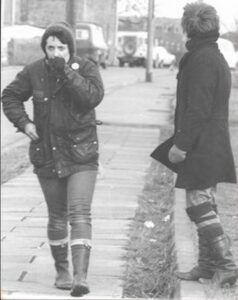
Anna on the picket line in Sacriston (c) Ethel Claughan & Anna Lawson
Women also organised discos to raise money and keep young people off the streets. They only got help from the men as ‘bouncers’ to handle unruly youths. Miners were reluctant to do this job, but women insisted that the discos would stop without their help.
At first, the Lodge also did the shopping for the food parcels, but their choices weren’t nutritious. Women suggested better alternatives, carefully, to avoid offending them. Then eventually, the Lodge let some of the women go with them to do the shopping. Whilst it sometimes felt like everything and everyone was against them, the women found ways to get the job done.
We could only use the school kitchen in the holiday periods, and we had to follow very strict rules laid down by the council. The council also wanted us to buy from their suppliers – it was crazy as they were much more expensive than the cash and carry. We had to prove that we had used them, but then we used to get other things and just sneak them in, but they would have inspectors coming out to check. It was a hard slog. We fed about 300 families.
Undeterred, the women of Sacriston sought innovative solutions, such as establishing a second-hand shop. This initiative not only provided financial support but also served as a sanctuary for miners’ wives, fostering solidarity and support amidst adversity.
Their struggles extended beyond the confines of Sacriston too. The Department of Health and Social Security’s punitive measures, deducting benefits for receiving food parcels, exemplified the systemic challenges women faced, including from the police.
When we were out picketing, we were thrown to the ground, we were handcuffed. We were treated like the men. In fact, when the police were in the village, they targeted the women, stopping them in the street, questioning the whereabouts of their children.
Although their efforts were not without internal tensions, the women navigated these bureaucratic hurdles and male dominance to ensure the well-being of their community. Balancing loyalty to the union with the need for autonomy, women traversed delicate relationships within the community. And despite resistance from entrenched Lodge officials, support from younger NUM members offered a glimmer of hope amidst the strife.
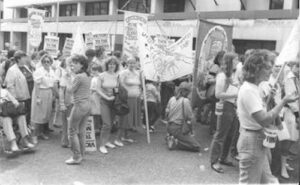
Demonstration outside BBC Newcastle (c) Ethel Claughan & Anna Lawson
Sacriston’s women demonstrated resilience and solidarity, their contributions integral to the fabric of the strike. Anna’s first-hand account serves as a poignant reminder of the sacrifices made by women in the mining communities, a history often overshadowed by tales of male heroism.
As we reflect on the legacy of the miners’ strike, we need to remember the untold stories of women like Anna, whose courage and perseverance continue to inspire generations. Theirs is a legacy of resilience, defiance, and unwavering solidarity.
Which we honour again in July with We’re Not Going Back, including a trip to Durham. Book here!
John Heywood
Main picture: Anna at a rally in Sheffield (c) Ethel Claughan & Anna Lawson
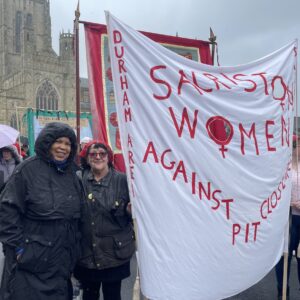
Anna with Red Ladder’s Artistic Director Cheryl Martin at the Durham WAPC march 2024